

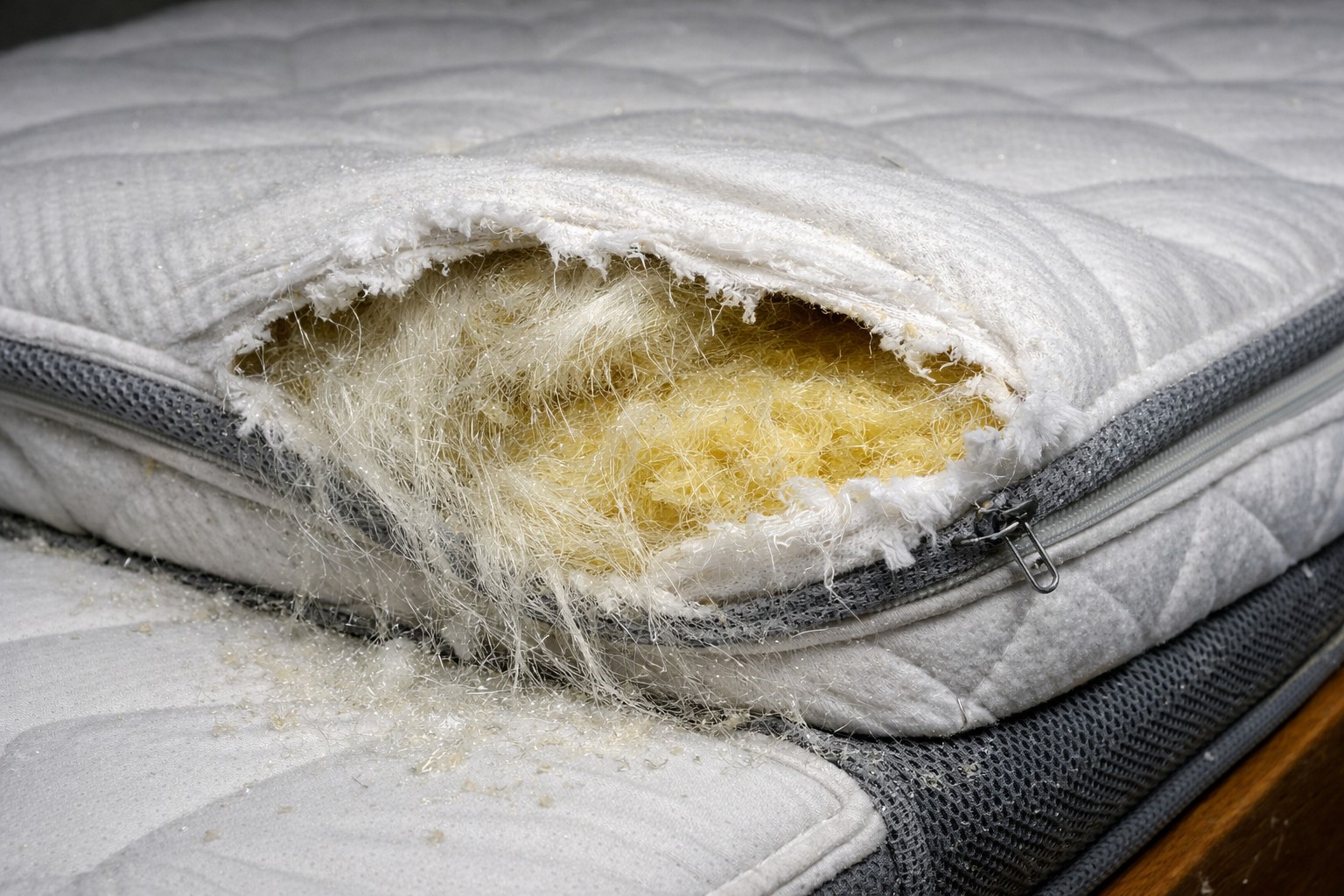

You washed a mattress cover. It had a zipper. It felt like the kind of thing you’re supposed to take off and clean. Nothing on it warned you otherwise. And now there’s something fine and glittery on your sheets, your floor, maybe your clothes — and your chest feels tight, or your skin won’t stop itching, and you are quietly convinced you just poisoned your own home.
You are not stupid, and this is not your fault. What you’ve found is fiberglass — the fine glass fibers built into many mattress covers as a fire barrier — and a zipper is a universal “open me” signal. Thousands of people did exactly what you did, for exactly the same reason: they were being responsible and tidy. The community that’s been through it says it plainly:
“You are not stupid and this is not your fault. Most people don’t even know that fiberglass is in mattresses. Why would they think it would be in there?”
— homeowner, r/MattressAnd if fibers turned up without anyone ever opening the cover — the “I did nothing” case — you’re not imagining it and you didn’t cause it. We’ll come back to the honest state of the science on that, and exactly what to do, in section 7. You’re not the exception that proves you did something wrong.
The whole article, in three sentences
- The instinct to clean it up fast — unzip, vacuum, wash, run a purifier — is the thing that spreads it; the most useful first move is almost the opposite of cleaning.
- The science is calmer and more accurate than what you’ve probably read: fiberglass is a mechanical irritant, not asbestos, and the cough, the rash, the itchy eyes are real and expected — but interstitial lung disease and cancer are not the story here.
- The one thing you genuinely cannot do on your own is prove where the fibers actually went — which is why an independent measurement, not a frantic afternoon of cleaning, is the move that ends the spiral.
This article is for education only. IndoorDoctor provides environmental testing — we identify what’s present in a sampled area and where. We don’t remediate, and we don’t diagnose. If you have health concerns about an exposure, talk to a licensed healthcare provider.
Table of Contents
- What’s actually happening: a contamination event, not a bad mattress
- It looks like asbestos. Here’s the one difference that changes everything.
- What fiberglass exposure does to your body — and what it doesn’t
- What to do in the first hour (and what makes it worse)
- Why it takes over the whole house — and why cleaning feels never-ending
- You can’t prove it by eye — the honest witness
- How to check before you buy — or before you unzip anything
- Why is fiberglass even in there?
- Is this in the news?
- Common questions
- The clear next step
- Resources: statistics, glossary, and references
Section 01
What’s actually happening: a contamination event, not a bad mattress
The single most useful thing to understand is this: a fiberglass mattress is not “broken.” Sealed and zipped, the fiberglass layer is doing nothing to you. It’s an inert reservoir — a fine glass “sock” woven around the foam core, sitting still, releasing essentially nothing into the air you breathe. The problem doesn’t start with the mattress. It starts the moment something breaks containment — a cover unzipped, torn, washed, or worn open over years — and the fibers get out into the room.1
That reframe matters because it tells you what kind of problem you have. This isn’t a housekeeping failure you can scrub away, and it isn’t a single defective object you can throw in a dumpster and forget. Once fibers are loose, you have a small-scale indoor contamination event, and it behaves like one: the fibers settle onto every surface, then get lifted back into the air whenever something disturbs them — footsteps, a vacuum, the heating and cooling system, a hand smoothing the sheets.2 That settle-and-relift cycle is why people clean the same room for weeks and feel like they’re getting nowhere. The fibers aren’t indestructible. They’re just being handed energy, over and over, by the cleanup itself.
The organizing rule for everything below: the fibers are inert until you give them energy. Where they actually went — which rooms, how far, whether the heating ducts moved them — isn’t something you can guess by looking. It’s something you measure. Hold that thought; it’s the hinge the whole article turns on.
Section 02 · The science, calmly
It looks like asbestos. Here’s the one difference that changes everything.
Short version: fiberglass is not asbestos, and that single fact reorders the entire problem. The mattress fibers are real, the irritation is real — but the chain of fear you may have read about (lung cancer, pulmonary fibrosis, “cuddling with death”) is not supported by what these fibers physically are or how your body handles them. Here’s the one difference that does all the work.
Asbestos
- Crystalline — has cleavage planes
- Splits lengthwise into ever-thinner, ever-longer needles
- Burrows deep and resists clearance
- Stays in the lung for decades
- IARC Group 1 — known carcinogen
Glass fiber (mattress)
- Amorphous — no cleavage planes
- Breaks across into shorter fibers of the same diameter — shorter, never thinner
- Dissolves and clears in days to weeks
- Largely gone within a year
- IARC Group 3 — “not classifiable”
Asbestos is a crystalline mineral. It has built-in cleavage planes, so a single fiber splits lengthwise into ever-thinner, ever-longer needles that burrow deep, resist your body’s cleanup crew, and stay put for decades.3 Glass fiber is amorphous — non-crystalline, no cleavage planes — so it can’t split that way. Under stress it breaks the other direction, snapping across into shorter fibers of the same diameter.3 It gets shorter, never thinner. And it dissolves: glass fibers clear from lung tissue in a matter of days to weeks, while asbestos persists for well over a year.4 One breaks down and gets swept out; the other digs in. That is the whole ballgame.
Glass fibers dissolve and clear; more than 95% are gone within a year, versus roughly 17% of amosite asbestos. This biological difference — not just fiber shape — is why the two sit in completely different risk categories.4
This is why the world’s cancer authority puts them in completely different boxes. The International Agency for Research on Cancer (IARC) re-examined insulation glass wool in 2001 and moved it to Group 3 — “not classifiable as to its carcinogenicity to humans.”5 Two large worker studies — the U.S. and European cohorts of fiberglass-manufacturing workers, following thousands of people who handled the material for a living — found no consistent link to lung cancer or mesothelioma.5 Asbestos sits in Group 1 — known to cause cancer. They are not neighbors.
One honest caveat, because accuracy cuts both ways: Group 3 does not mean “proven safe.” It means the evidence isn’t sufficient to classify it as a carcinogen — a different and more modest statement than “harmless.”
And the mattress fiberglass we’re talking about is the ordinary glass-wool family — the same material that goes into fiberglass insulation in your home — not the rare, fine, specialty glass microfibers that sit in a more cautious category and never go near a mattress.5 So the accurate sentence isn’t “it’s not asbestos, so you’re fine.” It’s: it’s not asbestos, the cancer-and-fibrosis fear is misplaced, and the irritation you’re feeling is real and worth taking seriously. That’s what the next section is about.
Section 03 · Your body
What fiberglass exposure does to your body — and what it doesn’t
Here’s the plain answer first: fiberglass irritates wherever it physically lands — skin, eyes, and the upper airway (nose, mouth, throat). Those effects are real, common, and usually ease once the source is gone. The measured fibers are too large to reach the deep, gas-exchanging part of the lung, which is why the serious lung diseases get ruled out — but it’s also why the cough and the rash and the gritty eyes are exactly what you’d predict. Your symptoms aren’t proof of catastrophe. They’re proof of contact.
The size is the reason. Glass fibers measured in mattress covers run about 5–10 micrometers across — well above the under-3-micrometer threshold a fiber has to clear to penetrate deep into the lungs.6 That’s their physical width. What governs how deep a fiber travels, though, is its aerodynamic diameter — and because inhaled fibers align with the airflow, these fragments behave like 30–50-micrometer particles in the air.7 That’s still big enough to land in your nose, mouth, and throat (where the irritation is), and far too big to reach the alveoli. The discomfort is a mechanical irritant effect — stiff glass spicules physically abrading skin and the lining of your airway, like microscopic splinters — not an allergy and not a toxin building up in your system.8
This is what makes the early days so confusing. People mistake it for a cold, for allergies, for bed bugs. One homeowner described a partner who “thinks his new apartment has bugs… only to discover the itching persists… Then he pulls shards of fiberglass out of [his] skin. They are literally cutting him in his sleep.” The discovery is upsetting; the mechanism is mundane — fibers on the bedding, fibers on the skin.
| Body system | What people commonly report | Why it happens |
|---|---|---|
| Skin | Itching, prickling, a bumpy or follicular rash, “shards I can pull out” — often worst at the wrists and inner elbows | Mechanical irritant contact dermatitis: stiff fibers pierce the outer skin layer. Notably, thicker and shorter fibers irritate skin more. Reversible; not an allergy.8 |
| Eyes | Grittiness, redness, watering, “something in my eye” | Surface irritation from fibers that have settled and made contact. |
| Upper airway (nose, mouth, throat) | Sore throat, dry cough, hoarseness, “thought I was getting a cold” | Fibers this size deposit by impaction in the upper airway — where the irritation is — not deep in the lung.7 |
| Lower respiratory | Coughing fits, chest discomfort, “hacked my lungs out” | Real acute irritation plus understandable anxiety. At the measured fiber size, deep-lung deposition isn’t the expected pathway — this is not a fibrosis or cancer signal.67 |
| Whole-pattern tell | Symptoms ease when you’re away from home and return when you come back | A classic indoor-exposure pattern — the “tell” that points at the source inside your house. |
A note for parents, because this fear is sharp: a worried response to your child’s exposure is legitimate. Crib and toddler mattresses have been found with undisclosed fiberglass, and kids spend more hours in closer contact with the surface.9 The honest read is that the documented effect for children, as for adults, is mechanical irritation — not demonstrated systemic disease. Take the exposure seriously; don’t let anyone catastrophize it into something the science doesn’t support.
One more accurate-and-validating point, straight from the compliance reality of this field: symptoms can flag an exposure, but their absence doesn’t prove your home is clear. Fibers settle out of the air within a day or two and sit quietly on surfaces, where they keep getting re-stirred.10 You can feel better and still have a contaminated reservoir in the carpet and the ducts. That gap between “how I feel” and “what’s actually here” is the whole reason measuring beats guessing.
Section 04 · First response
What to do in the first hour (and what makes it worse)
The plain answer is going to feel wrong — but remember the rule from section 1: the fibers are inert until you give them energy. Right now, the most useful thing you can do is almost nothing. Stop disturbing it. Every intuitive cleanup move — vacuum it, strip the bed, run the air purifier, throw the windows open and get a fan going — adds energy to settled fibers and relofts them into the air and into new rooms. The single rule for the first hour is don’t add energy to the system.
“2 gallons of vinegar, clarifying shampoo, dawn soap… running the air purifier 24/7… and it’s still showing up on everything. I’ve lost all hope.”
— homeowner, r/MattressThe effort wasn’t the problem. The type of effort was — most of it was relifting fibers as fast as they settled. Here is the calmer sequence.
Stop disturbing it. Get off the bed. Don’t unzip the cover, don’t strip the bedding, don’t shake anything out. If the mattress is the confirmed source, gently encase it in plastic rather than dragging it through the house. Dry agitation — sweeping, shaking, dusting — relofts settled fibers; it doesn’t remove them.11
Reduce air movement. Close the bedroom door. Turn off bedroom fans. As a precaution, shut off the central heating/cooling system — or at minimum, close the supply and return vents in the affected room — to stop forced air from pulling fibers into the ductwork. There’s no downside to switching it off. (Calibration: glass fibers load ductwork less aggressively than something like soot, so this isn’t an emergency — just no reason to leave it on.)12
Keep people and pets out — especially small children, who spend the most time closest to the floor where fibers settle.9
Don’t vacuum unless it’s a fully sealed True HEPA or ULPA machine. This is the trap that gets almost everyone. An ordinary vacuum captures only about half to two-thirds of the dust it picks up; the rest gets blown back out through the exhaust, often broken into finer pieces.11 And watch the label: a vacuum marked “HEPA-type“ is not the same as a sealed True HEPA unit. If you’re not certain your vacuum is fully sealed True HEPA, don’t vacuum at all. Damp-wipe hard surfaces with a wet microfiber cloth instead — wet capture binds the fibers so they can’t relift. As the forums put it: “Always make sure to use a wet cloth instead of a dry cloth because dry cloths will make the fiberglass go even more places.”
Don’t start cleaning blind. This is the highest-value move and the one nobody thinks of: before you spend a single weekend scrubbing, find out where the fibers actually went. Cleaning one room thoroughly while the fibers have already traveled to three others is how the “I cleaned and it came back” loop starts. Map the footprint first, so your effort is aimed instead of scattered. (More on that in section 6.)
The cleanup instincts, sorted by whether they add or remove energy:
| The instinct (adds energy) | Why it backfires | The correct move (removes energy) |
|---|---|---|
| Unzip / remove the cover to “clean” it | Exposes the bare fiberglass sock; fibers aerosolize room-wide | Leave it zipped and intact. If you suspect fiberglass, never open it. |
| Vacuum with a standard or “HEPA-type” vacuum | Unsealed housing exhausts fine fibers back into the air | Only a fully sealed True HEPA/ULPA vacuum — or don’t vacuum; damp-wipe instead.11 |
| Run the HVAC, fans, or an unsealed air purifier | Forced air can move fibers through the house and load the ducts | Shut off HVAC and fans. Isolate the room.12 |
| Wash contaminated bedding in the home washer | Fibers embed in the drum; future loads pick them up | Discard heavily contaminated textiles; launder salvageable items off-site, then clean the machine.13 |
| Dry sweep, dust, or shake out the bedding | Dry agitation relofts settled fibers | Wet methods only: damp microfiber, top to bottom.11 |
| Assume an at-home pass “got it all” | Fibers stay embedded in carpet and soft goods, re-seeding the room | Map the footprint first; remove soft goods that can’t be cleared.14 |
Section 05 · The spread
Why it takes over the whole house — and why cleaning feels never-ending
The plain answer: the fibers spread because you carry them, and the cleanup feels endless because you can’t see when it’s done — not because the fibers are impossible to remove.
Once fibers are loose, three vehicles move them well past the bedroom. They embed in clothing and ride from room to room — in one study, nearly half of particles seeded on clothing resuspended and dispersed to every room of a test house during an hour of light walking.15 They get pulled into the heating-and-cooling system and redistributed through the ducts.12 And they settle into carpet and upholstery, which act as deep reservoirs that release fibers back into the air every time someone walks across or sits down.2 (If you want the physics of how fine particles travel and settle indoors, our explainer on what an air-quality monitor can and can’t see covers exactly this.) This is also how people who never touched the mattress — partners, kids, even pets — end up itching.
“I can’t sit on the furniture in my house or wear any of the clothes we had in laundry piles without immediately getting itchy. We can’t shower without drying off with paper towels, because our towels are also covered.”
— homeowner, r/MattressThat brings us to the most demoralizing part — the sense that you’ll never be finished. It’s worth naming precisely, because the despair in these accounts is real:
“I’ve watched my favorite clothes be covered, my blankets and full sheet sets destroyed… I’ve cried every day since discovering this issue because it’s a constant stress of cleaning and worry that it’s impossible to remove… I’ve lost all hope.”
— homeowner, r/MattressHere is the reframe that actually helps. The reason the cleanup feels bottomless isn’t that the fibers can’t be removed — it’s that you have no way to see completion. You can’t tell by looking whether a room is clear, so the work has no defined endpoint, so it becomes compulsive. That’s not a fiber problem. That’s a measurement problem — and measurement problems have solutions. The fix for “am I ever done?” isn’t more scrubbing. It’s a check that gives you a real answer.
Section 06 · The proof gap
You can’t prove it by eye — the honest witness
The plain answer: the reason this is so maddening is that you can see it and still can’t prove it — and the fix is the same one the law already requires for asbestos, lead, and mold: an independent reading from someone with no stake in the cleanup.
Start with the proof gap, because every homeowner hits it. The fibers are too fine to photograph — your phone can’t focus on them — so you can’t document the damage for a landlord, an insurer, or a manufacturer. You can’t trust the popular flashlight-in-a-dark-room test either: it lights up polyester from your pajamas just as readily as fiberglass, so it produces both false alarms and false comfort. One homeowner captured the specific insanity of it:
“It is crazy-making to see something with your own eyes and be able to show it to someone in person who will agree that they see it but then be completely unable to capture a photo of it.”
— homeowner, r/MattressNow the part almost nobody tells you. Every mature field that deals with invisible particles — asbestos, lead, mold, fire-soot restoration — has independently arrived at the same rule, and it’s written into law: the company that removes the contamination is not allowed to be the company that certifies it’s gone.
The logic is identical every time: don’t let the party paid to do the cleanup be the party that grades it. There’s no equivalent law for fiberglass in a bedroom — no one wrote an asbestos-style rule for your mattress. But the role those laws protect is exactly the role an independent testing service fills.
This is the part of IndoorDoctor’s model that’s built for this moment: we test, and only test. We don’t sell remediation, so “get it measured first” isn’t a setup for a cleanup bill — we don’t have one. What testing does is map where the fibers settled and how far they traveled — sampling beyond the obvious source, because contamination almost always exceeds the visible zone.19 You get an objective reading instead of a guess, and a live Zoom consultation with a credentialed expert who walks you through what it means. You walk away knowing what’s present, where it went, and what your next step is.
That measurement is also what resolves the two separate decisions tangled together in your head right now. There are two clocks, not one.
If it’s the confirmed source, bag it and stop using it. Whether to replace it with a fiberglass-free model is a straightforward product choice.
How far did the fibers travel, and how deep does the cleanup actually need to go? You can’t judge this by eye.
Testing is the hinge between them. It keeps you from over-reacting — moving out, trashing everything — and from under-reacting — wiping down one room while the ducts quietly re-seed it. One homeowner described being stuck exactly in that gap: “Right now, I’m kind of in between cleaning the apartment myself and risking my health or moving out.” A footprint map is what gets you unstuck.
You can read more about why an independent indoor-air assessment beats guessing and what professional, testing-only assessment looks like — the same no-conflict model applies to a fiberglass event.
Section 07 · Before there’s a problem
How to check before you buy — or before you unzip anything
If you’re reading this before a problem — shopping for a mattress, or staring at a zippered cover wondering whether to wash it — the plain answer is: don’t open a cover that tells you not to, and you can largely sidestep this whole category at purchase.
First, scale. The viral version of this story is “fiberglass is in most cheap mattresses.” That’s not what the best data shows.
The contaminated share concentrates in lower-priced memory foam and hybrid beds — and the industry has been actively phasing fiberglass out. So this is a real minority case to check for, not a near-certainty to panic about.
How to check, honestly:
- Read the law tag and the materials list. Glass fiber, “glass wool,” or a fire sock you can’t identify is a flag. There’s no federal requirement to disclose fiberglass prominently, so absence of the word isn’t proof of absence — but its presence is a clear signal.
- Never unzip a “do not remove” cover. Treat any zippered mattress cover carrying a do-not-remove tag as a possible fiberglass barrier. The zipper is not an invitation; the tag is the instruction. The fibers stay contained only while the cover stays closed.1
- Prefer a non-fiberglass fire barrier. Mattresses made with wool, rayon, or silica-based barriers meet the same federal fire-safety standard without the contamination failure mode.21 You’re not choosing between “fire-safe” and “fiberglass-free” — you can have both.
- The flashlight test is a hint, not a verdict. In a dark room, a flashlight raked across the sheet will show fiberglass as pin-straight glints. But polyester glints too, so a “positive” here is a reason to confirm, not a diagnosis.
If fibers turned up without anyone ever opening the cover, you’re not imagining it and you didn’t cause it. These reports are well-documented in consumer accounts and deserve to be taken seriously. Here’s the honest state of the science: the lab work to date has tested new covers, where fibers stayed contained; how covers behave after years of wear, washing, or pet damage hasn’t been formally studied — so it’s plausible but unconfirmed rather than proven. (Some “I did nothing” sightings are also polyester from bedding, which glints like fiberglass under a raking flashlight.) The honest move is the same one this whole article points to: if symptoms track your home, confirm where the fibers actually are with professional sampling rather than assuming either way.
If you’ve confirmed fiberglass in your mattress but haven’t had a release event: keep the cover sealed, never unzip it, and consider a professional assessment before any disturbance — moving it, storing it, or washing it. That’s the prevention path, and it uses the same independent measurement section 6 describes for post-event situations.
If you want the deeper version of the buying-and-detection question, our guides on airborne fiberglass in newer homes and why at-home test kits miss things cover the same “you can’t always see it” problem from other angles.
Section 08 · The honest counterweight
Why is fiberglass even in there?
It’s a fire barrier — a legally required one, and a documented life-saver. Federal law requires every mattress to resist an open flame; fiberglass is the cheapest way to comply. The question is fair, and the honest answer is that the enemy isn’t fiberglass — it’s a cover that can be opened and a label that doesn’t say what’s inside.
Federal law — the Consumer Product Safety Commission’s open-flame mattress standard (16 CFR Part 1633) — requires every mattress to have a barrier that slows a fire.22 Under flame, the glass sock softens into a layer that shields the foam core and buys escape time. Fiberglass is simply the cheapest way to meet that requirement — it isn’t mandated; wool and rayon-silica barriers do the same job. And the requirement works:
Mattress and bedding fires still cause around 300 deaths a year in the U.S.25 So the barrier is doing real work.
The honest takeaway: the trade-off isn’t “hazard versus no hazard.” It’s which fire barrier, and whether the cover stays sealed. Fiberglass causes trouble only when its containment is breached — and there are non-fiberglass barriers that avoid that failure mode entirely while still meeting the standard. That’s why the fix is about containment integrity and disclosure, not banning a material that prevents bed-fire deaths.
Section 09
Is this in the news?
Briefly, and only because it tells you you’re not imagining the scale: yes. Fiberglass-mattress contamination is the subject of active litigation. A pending class-action settlement involving Ashley and the Nectar/DreamCloud/Siena brands carries a court-documented $9 million fund covering 70-plus mattress models.26 It’s described as preliminary — pending final approval — so treat it as evidence the issue is real and widespread. The relevant point for you isn’t the lawsuit. It’s that a problem this documented deserves a real measurement, not a guess.
Section 10
Common questions
Is fiberglass in a mattress dangerous?
It causes real, uncomfortable irritation — itchy skin, gritty eyes, a sore throat or cough where fibers land — but it is not asbestos and it is not a cancer or lung-scarring risk. The world’s cancer authority classifies the relevant glass wool as Group 3, “not classifiable as to its carcinogenicity.” The fibers measured in mattress covers are too large to reach the deep lung. So the symptoms are worth taking seriously, but the deadly framing you may have read online isn’t supported by what these fibers physically are.
Is fiberglass in a mattress the same as asbestos?
No. Asbestos is a crystalline mineral that splits lengthwise into ever-thinner needles, buries deep in the lung, and stays for decades. Glass fiber is amorphous — it breaks across into shorter fibers of the same diameter, and it dissolves and clears from lung tissue in days to weeks. That difference is why the two sit in completely different cancer-risk categories.
Do I have to throw the mattress away?
If the mattress is the confirmed source of loose fibers, the practical move is to bag it and stop using it. The harder, separate question is your home — how far the fibers traveled and how deep the cleanup needs to go. That’s not something you can judge by eye; it’s what professional sampling is for.
Can I clean up fiberglass myself?
Some of it, carefully — wet methods, a fully sealed True HEPA vacuum, no dry sweeping. But the instinctive moves (unzipping the cover, ordinary vacuuming, running fans and the HVAC) spread fibers rather than remove them. The bigger limitation is that you can’t see when a room is actually clear, which is why mapping where the fibers went comes before scrubbing.
How do I know if my mattress has fiberglass before there’s a problem?
Check the law tag and materials list for “glass fiber” or “glass wool,” and treat any zippered “do not remove” cover as a possible fiberglass barrier — never unzip it. A flashlight raked across the sheet in a dark room can hint at fibers, but polyester glints the same way, so it’s a reason to confirm, not a verdict. Choosing a mattress with a wool, rayon, or silica fire barrier sidesteps the issue at purchase.
Section 11
The clear next step
If fibers are loose in your home, you don’t need to move out and you don’t need to throw everything away. You need to stop disturbing it, and you need to know where it went. That’s the calm, decisive move that ends the guessing — and it’s the one thing you genuinely can’t do on your own with a phone camera and a flashlight.
Schedule professional fiberglass sampling with a live Zoom consultation
IndoorDoctor is a New England–based, testing-only practice — founded in Derry, NH in 2009, with more than 30,000 inspections behind us and credentialed experts (CIEC, CMC) reading every result. Because we never sell remediation, the reading you get is independent: professional sampling with accredited-lab analysis, and an expert who walks you through what the results mean and what your next step is. We find out where the fibers settled and how far they traveled — so your cleanup is aimed, your decisions are bounded, and the spiral ends.
See Specialty Testing → or call 866-409-3166
Measurement replaces opinions with data — and when the thing you’re afraid of is invisible, data read by an expert who tells you what it means is what actually settles it. That’s the point: you get answers, not just data.
Reminder: IndoorDoctor provides environmental testing only. We identify what’s present in a sampled area and where; we don’t remediate, and we don’t diagnose health conditions. If you have health concerns related to an exposure, consult a licensed healthcare provider.
Resources
Statistics, glossary & references
Relevant statistics
| Stat | Value | Source / year |
|---|---|---|
| Tracked models confirmed to contain fiberglass | 7.8% (32 of 410) | NapLab, 2026 |
| Tracked models confirmed fiberglass-free | 89.5% (367 of 410) | NapLab, 2026 |
| Measured glass-fiber diameter in mattress covers | 5–10 µm (above the <3 µm respirable threshold) | Wagner et al., IJERPH, 2022 |
| Calculated aerodynamic diameter of cover fragments | ~30–50 µm (upper-airway, not deep-lung) | Wagner et al., 2022 |
| IARC class — glass wool / continuous glass filament | Group 3 — not classifiable | IARC Monograph Vol. 81, 2001/02 |
| Glass-fiber lung clearance vs. asbestos (long fibers) | >95% glass cleared in 1 yr vs. ~17% of amosite | Hesterberg et al., 1998 |
| Standard (non-HEPA) vacuum dust-removal efficiency | ~50–60% (remainder re-aerosolized) | J. Building Eng., 2019 |
| Clothing-borne particles dispersing house-wide in 1 hr | ~46.8% resuspended to every room | PMC, 2021 |
| Open-flame mattress standard (16 CFR 1633) effective | July 1, 2007 | CPSC / eCFR |
| Deaths the standard was projected to prevent annually | 240–270 | CPSC, 71 FR 13472, 2006 |
| Bed-fire deaths estimated prevented annually (mid-rollout) | ~65/yr | NIST / CPSC, 2021 |
| Reduction in bed-fire deaths, 2005–06 vs. 2015–16 | 82% | NIST, 2020 |
| Annual deaths from mattress/bedding-origin home fires | ~300 (12% of home-fire deaths) | NFPA, 2025 |
| Resident Home / Ashley settlement fund (preliminary) | $9 million, 70+ models | Forbes Vetted, 2026 |
Glossary
- Amorphous
- Non-crystalline — without an ordered internal structure or cleavage planes. Glass fiber is amorphous, which is why it breaks across into shorter fibers of the same diameter rather than splitting lengthwise into ever-thinner needles the way crystalline asbestos does. This is the core physical reason fiberglass is not asbestos.
- Contamination event
- A situation where a substance has been released and spread into an indoor environment, settling onto surfaces and getting re-stirred into the air. The term reframes loose fiberglass as something with a footprint to be measured and bounded — not a single defective object, and not ordinary dirt.
- Irritant contact dermatitis
- A skin reaction caused by something physically or chemically abrading the skin — not by an allergy. Fiberglass dermatitis is the mechanical form: stiff glass fibers pierce the outer skin layer like microscopic splinters. It is reversible once contact stops, and thicker, shorter fibers tend to irritate skin more.
- HEPA / “HEPA-type”
- True HEPA is a high-efficiency filter standard, and a fully sealed True HEPA (or ULPA) vacuum captures fine fibers without leaking them. A vacuum labeled “HEPA-type” uses a similar-grade filter in an unsealed housing — so the motor’s exhaust pushes fibers back into the air through the seams. For a fiberglass event, the label difference matters: sealed True HEPA helps; “HEPA-type” can make it worse.
- Mechanical irritant
- A substance that causes discomfort by physical action — abrasion, piercing, lodging in tissue — rather than by a toxic chemical reaction or an immune (allergic) response. Fiberglass irritates skin, eyes, and the upper airway mechanically, which is why the effects are localized to where fibers land and ease once the source is removed.
- Respirable fiber
- A fiber small enough to penetrate deep into the gas-exchanging part of the lung — by the WHO/OSHA definition, under 3 µm in diameter, longer than 5 µm, with a length-to-width ratio of at least 3:1. Measured mattress-cover glass fibers (5–10 µm in diameter) are above this threshold, which is why their dominant effect is upper-airway and skin irritation rather than deep-lung deposition.
- Biopersistence
- How long a fiber stays in the body before dissolving or being cleared. Glass fibers are low-biopersistence — they dissolve in lung fluid in days to weeks. Asbestos is high-biopersistence, lasting well over a year. Biopersistence is the single biggest factor separating a low-concern fiber from a high-concern one.
- Independent clearance / verification
- The principle — written into asbestos, lead, and mold law — that the party who removes a contamination cannot be the party who certifies it’s gone. An entity that profits from the cleanup has an incentive to declare it finished, so the verdict is given to a party with no such stake. A testing-only service without a remediation arm occupies this independent-verifier role for a fiberglass event.
References & citations
| # | Source | What it supports |
|---|---|---|
| 1 | Wagner, Fowles & Barreau — “Fiberglass and Other Flame-Resistant Fibers in Mattress Covers,” IJERPH, 2022 | Fiberglass lives in an inner “fire sock”; exposure occurs on containment breach |
| 2 | “Walking-induced particle resuspension in indoor environments,” Atmospheric Environment, 2014 | Settled fibers re-aerosolize with walking, vacuuming, and airflow |
| 3 | Synthetic vitreous fibers review, Critical Reviews in Toxicology, 2023 & NRC, “Asbestiform Fibers” | Amorphous glass breaks transversely; crystalline asbestos splits lengthwise into thinner fibrils |
| 4 | Hesterberg et al., lung biopersistence study (amosite), 1998 & biopersistence/dissolution review | Glass fibers dissolve and clear orders of magnitude faster than asbestos |
| 5 | IARC Monograph Vol. 81 (man-made vitreous fibres) & NCBI mirror | Insulation glass wool reclassified to Group 3 (2001); Group 3 ≠ proven safe; special-purpose fibers are a separate 2B exception |
| 6 | Wagner et al., IJERPH 2022 & ATSDR Tox Profile for Synthetic Vitreous Fibers | Measured fiber diameter 5–10 µm, above the <3 µm respirable threshold |
| 7 | Wagner et al., IJERPH 2022 | Cover fragments ~30–50 µm aerodynamic — inhalable to nose/mouth/throat, too large for the deep lung |
| 8 | DermNet, “Fibreglass dermatitis” | Mechanical irritant contact dermatitis (not allergy); thicker/shorter fibers irritate skin more; reversible |
| 9 | ATSDR Toxicological Profile for Synthetic Vitreous Fibers & Wagner et al. 2022 | Children’s exposure concern is legitimate; documented effect is irritation, not demonstrated systemic disease |
| 10 | ATSDR Toxicological Profile for Synthetic Vitreous Fibers | Airborne levels settle within ~1–2 days; the persistent issue is the settled surface reservoir |
| 11 | Resuspension / vacuum-efficiency review, J. Building Eng., 2019 & Illinois DPH fiberglass guidance | Standard vacuums (~50–60% efficient) and dry sweeping re-aerosolize fibers; use sealed HEPA + wet methods |
| 12 | ATSDR Tox Profile & ANSI/IICRC S700:2025 overview | Forced-air systems can move fibers into ductwork and house-wide; shut off HVAC during an event |
| 13 | DermNet, “Fibreglass dermatitis” | Home washers retain fibers and cross-contaminate future loads; launder off-site or discard |
| 14 | Wagner et al. 2022 & field-report consensus on embedded soft-goods fibers | At-home cleanup misses fibers embedded in carpet/upholstery; map the footprint first |
| 15 | Clothing deposition/resuspension experiment, PMC, 2021 | Clothing carries fibers room-to-room; non-handlers (kids, partners) get exposed |
| 16 | EPA — AHERA independent-clearance Q&A (40 CFR 763) | Asbestos clearance must be performed independently of the abatement contractor |
| 17 | EPA — Lead Renovation, Repair & Painting clearance steps (RRP / HUD) | Lead clearance in federally assisted housing must be done by someone independent of the renovation firm |
| 18 | IICRC/SCRT — Post-Remediation Verification (S520) | Mold verification by an independent professional with no business affiliation to the remediator |
| 19 | ANSI/IICRC S700:2025 overview & InspectAPedia — mold clearance | Contamination routinely exceeds the visible zone; sample beyond the obvious source |
| 20 | NapLab — “List of Mattresses With Fiberglass — 410 Mattresses Analyzed” | ~7.8% confirmed with fiberglass / ~89.5% confirmed free; concentrated in lower-priced beds |
| 21 | Poison Control, “Why Do Mattresses Contain Fiberglass?” & Sleep Foundation | Wool, rayon, and silica barriers meet the fire standard without fiberglass |
| 22 | CPSC / eCFR — 16 CFR Part 1633 (open-flame mattress flammability standard) | Federal law requires a fire barrier; fiberglass is one low-cost way to comply, not a mandate |
| 23 | CPSC — Federal Register 71 FR 13472 (final rule) | The standard was projected to prevent 240–270 deaths/yr at full stock turnover |
| 24 | NIST TN 2092 & NIST news release | ~65 bed-fire deaths/yr prevented mid-rollout; ~82% reduction 2005–06 vs. 2015–16 |
| 25 | NFPA — “Home Structure Fires” | ~300 deaths/yr from mattress/bedding-origin home fires |
| 26 | Forbes Vetted — “$9M Fiberglass Settlement” (Todd v. Ashley; preliminary) | Court-documented $9M settlement fund, 70+ models — evidence the issue is real and widespread |
Field-report / consumer sources (used for quoted homeowner experience, not for scientific claims): r/Mattress, r/legaladvice, r/moderatelygranolamoms (via canonical Reddit permalinks); Newsweek; Yahoo Lifestyle; FOX San Antonio. Quotes are verbatim and anonymized.